Gas grill
May 11, 2026
Cleaning & Adjusting Gas Grill Burners: What to Do When Jets are Clogged and Burners are Hissing?

Lisa KilimannFrau Mayonnaise
You want to relax and have a barbecue, but something isn't right – the gas grill lights up, but doesn't burn? The flame is too weak, uneven, yellow, or goes out? Or your burner hisses, whistles, roars, pops, whistles, bubbles, or makes unusual, loud noises?
Good News: No need to worry – these problems can indeed occur with gas grills, but in most cases they can be explained by dirty burners and clogged gas nozzles. Even better: You can easily fix most issues of this kind by cleaning and adjusting the burners and nozzles yourself. Here's how!
Step 1: Identify the gas grill problem

Possible errors, issues, and irregularities with your gas grill are best identified by examining the flame pattern and the burner sounds.
Tip: The best way to check is in the dark and after about 10 minutes of heating up.
If the burners reliably produce heat, burn calmly and evenly with a slightly blue flame, everything is fine. If you notice changes in the behavior of the flames and/or burners or if one of the following phenomena occurs with your gas grill, there may be an issue:
You let the gas flow for about 3 seconds, the spark appears, but the burner doesn't ignite?
That's not how it should be – sounds like no gas is reaching the burner!
The burner ignites and forms flames. However, the flame is very weak, has gaps, does not generate proper heat, or goes out intermittently?
This is not how it should be – sounds like there might be issues with the gas supply!
The burner ignites and forms a flame. However, the flame is (strongly) yellow instead of blue, flickering around the burner (and producing soot), like a candle?
This should not be the case, such flames only generate low temperatures - sounds like an imbalance in the air-gas mixture, arriving at the burner with too little oxygen!
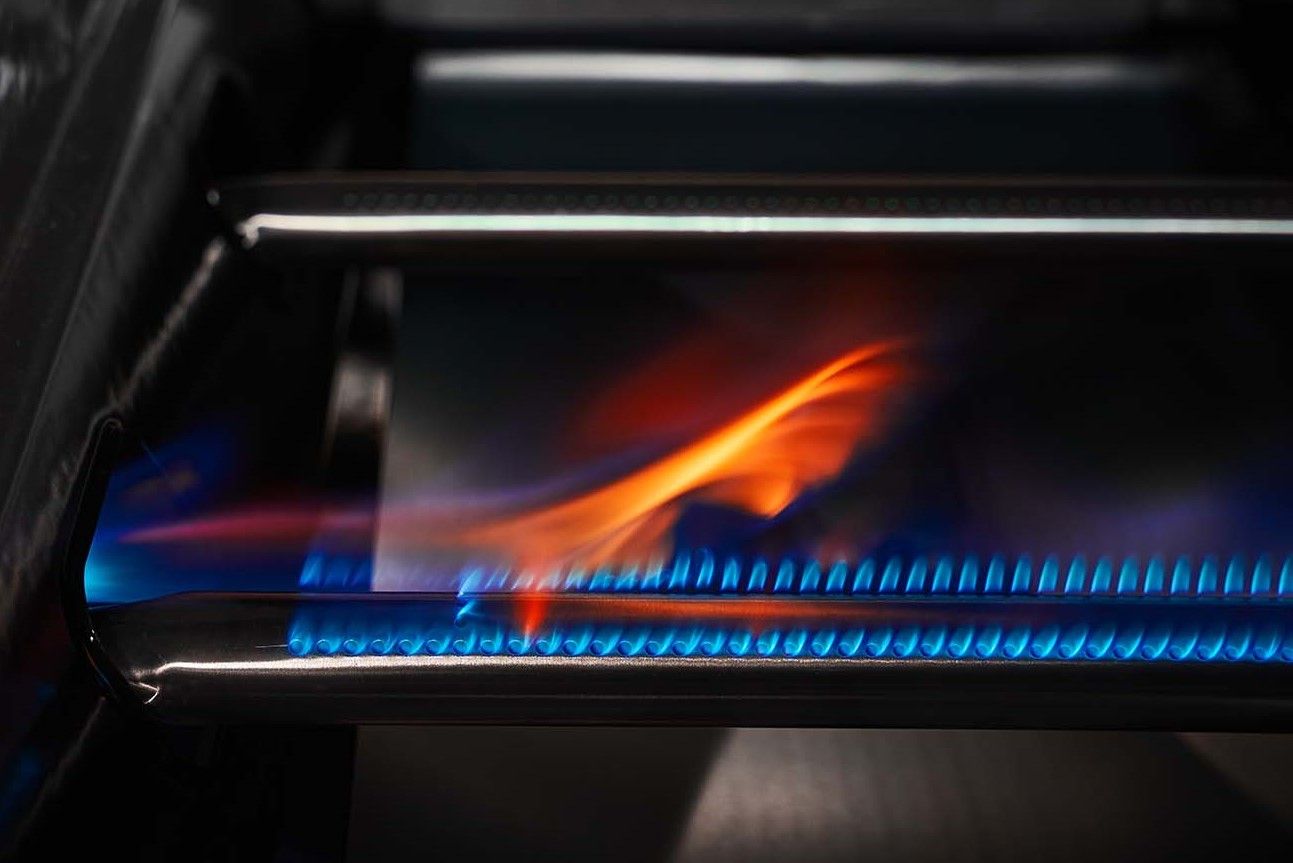
The burner ignites and forms a flame. The flame is normally blue, occasionally showing calmer bright-orange flames that do not move or flicker?
There is no underlying issue here - sodium salts are burning here, which have dripped onto the burner tubes along with marinade & Co. This is completely normal, resolves itself, and has no negative impact on burner performance.
The burner ignites and forms a flame. However, the flame is (strongly) blue, flickers restlessly, visually lifts off from the burner tube, or even goes out completely?
This is not how it should be, such flames are also called "jet flames" – sound like an imbalance in the air-gas mixture, which arrives at the burner with too much oxygen!
The burner ignites and forms a flame, but makes loud, atypical noises, often accompanied by an irregular flame pattern?
This is not how it should be - sounds like there might be an issue with the gas supply and/or the air-gas mixture.
The (infrared) burner ignites and forms a flame and runs. Directly after ignition or after 10-20 minutes, a sudden "popping" or "flap" noise can be heard before the burner goes out abruptly. Shortly after, a "hissing/roaring" sound similar to a welding torch can be heard.
ATTENTION, fire hazard! Turn off the grill and gas supply immediately! There is likely a gas backup - the result when nothing works due to clogged gas nozzles, dirty burners, and insufficient oxygen supply.
Just like with the tube burners, changes in the flame pattern or hissing, bubbling noises can also occur with your infrared ceramic burner.
If the ceramic burner does not ignite or reach temperature, just like with the tube burners, the gas supply or (if located in the side table) the power supply may be affected.
Dark spots on the burner are usually not a cause for concern – they do not affect the burner's performance. However, cracks in the ceramic should be clarified with the manufacturer before further use. If you have a BURNHARD grill, contact us for safety!
You have noticed irregularities in one or more of your burners? In most cases, a disturbance in the uniform gas supply and a non-ideal composition of the air-gas mixture are the issues that are necessary for an optimal flame pattern and smooth burner operation.
The following causes are particularly common:
The factory setting of a gas grill is already optimally regulated and tested and approved for this setting. However, during the production of the grill, production residues may remain that burn and can cause crackling, bubbling noises, or small sparks at the burner when you first start up your gas grill.
Solution: After the first burnout, all residues should be burnt and the problems should have been solved automatically.
One of the most common causes of impure flame images and burner noises are contaminants in the burner tubes:
Solution: Remove and replace the (affected) burners with one that works well. If the problem moves with it, the issue lies with the burner. If it doesn't move, then the nozzle is to blame, not the burner. Clean the burners - find out how in "Step 3"!
If your grill is in the open state or has gotten wet during cleaning? Then moisture may have accumulated in the burner tubes or on the igniter, preventing the grill from starting or disrupting gas supply.
Solution: Remove the burner(s) affected, inspect and clean them. Allow them to dry thoroughly before reinserting.
It is not only the burner tubes that are frequently clogged, but also the built-in gas nozzles of the regulator unit, which guide the air-gas mixture into the burner tube. If these are not cleaned over an extended period of use, the fine nozzles often become clogged by hot grease vapors and dust. This can occur with both rod and ceramic burner nozzles.
Solution: Remove the (affected) burners and replace them with one that works well. If the problem moves with it, the issue lies with the burner. If it does not move, then the nozzle is to blame, not the burner. Clean the nozzles – you can learn how to do that in "Step 3"!
If your gas cylinder is not empty, the gas supply may also be disrupted or interrupted by a faulty pressure regulator or a leaky gas line. Signs of this include:
Solution: Perform a leak test on the gas supply (pressure regulator, hose, gas line). Only use the grill again once you have ensured the leak-tightness of all lines and connection elements.

If the spark does not occur despite the typical clicking sound even after 5 seconds of gas supply during the ignition attempt, it is possible that the ignition needles are too far apart from each other and from the ceramic field.
Solution: Carefully bend the ignition needles into the correct position:

If not all cables are properly connected in the ignition box and/or no full batteries are inserted, then your infrared burner in the side table may not ignite despite pressing the button.
Indicator: When pressing the ignition button, NO clicking is heard. If the typical clicking sound is heard when pressing the ignition button, the culprit is likely a clogged nozzle or bent ignition pins.
Solution: Check if all cables are properly connected in the ignition box and if full batteries are inserted.
As soon as you notice initial issues with use, you should take action immediately and check your grill for the described causes.
The danger: If the blockages become too severe, the gas will find another way - this is called a "gas backup"! The gas accumulates uncontrollably in unwanted places and can suddenly ignite, even behind covers or in gaps where you cannot immediately see the fire.
In case of gas backup and fire, immediately shut off the gas supply! To prevent a gas backup and ensure optimal gas flow, you should preferably regularly check and clean burners and nozzles.
To address the most common issues, you should first check and clean the burners (tubes) and gas nozzles of your gas grill – preferably even on a regular basis for prevention. Here's how:

Step 1: Remove the retaining clips securing the rod burners by squeezing them lightly and pulling them out.

Step 2: Release the burner tubes by sliding them sideways into the gap where the fuse clip was previously located.

Step 3: Carefully remove the burner tubes and clean them inside and out:
Brush them off from the outside to remove all dirt and rust spots and ensure all holes are clear – for stubborn dirt, use degreaser and grill cleaner. Clean the burner tubes from the inside with a narrow pipe cleaner brush that fits. IMPORTANT: If you used water and cleaner, make sure everything is well dried before reassembling.
You can use this time to also clean the now exposed gas nozzles (see instructions below).

Step 4: Reinsert the burner tubes in reverse order as you removed them.

Step 5: Make sure to correctly place the tube back onto the nozzle so that it completely disappears into the tube.

Step 6: Secure the burners in place with the securing clip once they are positioned correctly.

Step 1: Remove the safety spring and cotter pin that secure the rod burners.

Step 2: Unscrew the flame bridge to separate the burners from each other.

Step 3: Remove the burner tubes one by one and clean them from the outside and inside:
Brush them on the outside to remove all dirt and rust spots and make sure all holes are clear. Clean the burner tubes from the inside with a narrow suitable pipe cleaner brush. If you used water and cleaner, let everything dry thoroughly.
You can use this time to also clean the gas nozzles now exposed (see instructions below).

Step 4: Reinsert the burner tubes in reverse order as you removed them. Make sure to properly set the tube back onto the nozzle so that it completely disappears inside the tube.

Step 5: Tighten the flame bridge to all burners to fix them in the correct position.

Step 6: Secure each burner with its cotter pin and insert it firmly with the safety spring.
Is everything in place? Check it with this video:

If no gas reaches your burners or the flame is not clean, the culprit is the burner nozzle. If you can hear gas flowing but the burner doesn't ignite, it is likely due to the ignition nozzle.
The burner nozzle is clearly visible and can even be cleaned without having to remove the control unit from the grill.
To clean the ignition nozzle, it may be necessary to expose the gas manifold, unless you have a long enough needle to reach the nozzle.


The nozzle of the ceramic burner installed in the side table of the FRED Jr. is located at the end of the gas line on the back of the grill. Simply loosen the two screws that secure the gas line to access the nozzle and clean it.

With the side burner, the nozzle at the end of the gas line opens into the underside of the side table. Simply loosen the two screws that secure the transition fitting to access the nozzle and clean it.

Now carry out a functional test of all components to ensure that everything is correctly reassembled and functioning properly.

The best way to prevent problems with the burners is through regular cleaning of all burners and gas nozzles.
Treat your grill to an intensive deep cleaning before or after long periods of disuse, such as in winter or spring. If you use your grill frequently, you should clean the burners and nozzles about twice a year. This way, you can always go full throttle and avoid problems before they arise!
Whether it's Hash Browns, Miso Eggplant, or spicy Cauliflower Wings - hell, yes! Lisa appreciates not ONLY steak and the like in her grill tongs! Her greatest culinary love lies with the secret stars at the BBQ buffet: side dishes and dips! Her BURNHARD heart makes a big leap with self-made fries and a thick dollop of mayo! With or without meat - with Kilimann, it's killer, man!