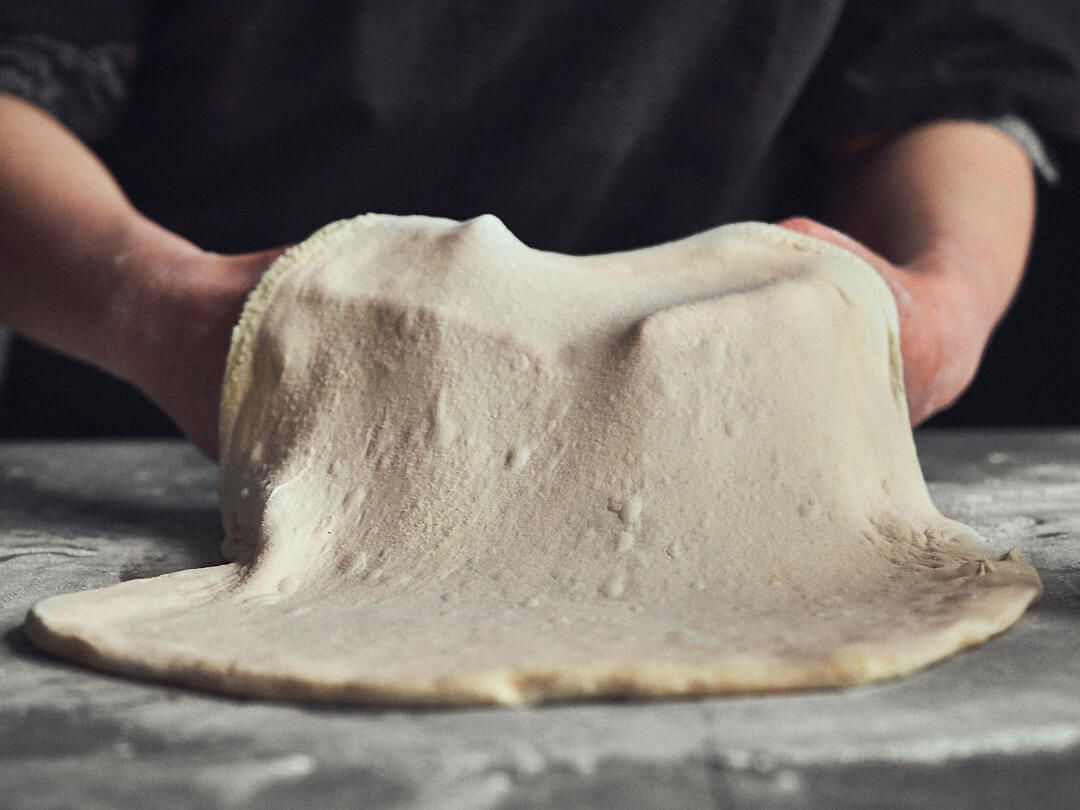
Flour, water, salt - that's it! That's all you need to bake ultra-crunchy pizzas with a fluffy crust! Fluffy crust without yeast? You got it, because that stuff stays in the fridge from now on! As a true dough master, you mix your pizza dough with sourdough to create a top-notch slow-food pizza! Moreover, it's pretty much the most authentic pizza, since before industrial yeasts were available in supermarkets, a pizza with Lievito Madre (the Italian term for sourdough) was the standard!
Why a sourdough pizza is cooler and worth the time? Quite simple: The long fermentation time in the fridge makes a huge difference in flavor. The flour becomes more digestible through acidification (think gluten!). The best part: Acid binds water! This means your pizza dough can absorb more water without completely falling apart. And if you've ever delved into hydration and water ratios in doughs, you know exactly what this means: Bigger air bubbles in your pizza crust.
MY TIP:
With just 3 ingredients, you should pay attention to what goes into your dough for the best results. Try to avoid iodized table salt (iodine is antibacterial and can hinder the fermentation of yeast and sourdough) and carefully choose your flour. High protein content like in Manitoba flour (look for it in Italian food stores or online - it's a Canadian wheat variety that is extremely popular in Italy) can give your pizza a significant gluten boost, more elasticity, and airiness. If you want to get even more nerdy, check the W value. It tells you exactly how much water your dough can absorb without collapsing during rising. Everything above 270 W is perfect for pizza baking!
Product recommendations for Sourdough Pizza


Ingredients
For 4 servings
For the pre-dough
For the main dough
Nutrition per serving
- 508
- Calories
- 106g
- Carbs
- 1g
- Fat
- 15g
- Protein
Preparation in 9 steps
For the pre-dough: Mix wheat sourdough, flour, and water and let it rise for about 3 hours in a tall container at room temperature until it has doubled in volume.
For the main dough: Mix the pre-dough, flour, and water. Finally, add the salt and knead everything. Let it rest covered for 30 minutes.
Place the dough on a lightly floured work surface and knead for about 20 minutes until smooth (in the food processor, 3 minutes on low speed, then 4 minutes on high speed). The dough should be elastic, easily detach from the edge of the bowl, and not tear. Cover and let rest for 10 minutes.
Slightly moisten the work surface with water. Loosen the dough from the bowl with wet hands and stretch it out as thinly as possible on the work surface on all sides. Then fold in from all sides towards the center, turn over, and return to the bowl with the "seam" at the bottom.
Cover the dough and let it rise at room temperature for 3 hours, stretching and folding it every 60 minutes (a total of 2 times): Grab one side of the dough and pull it up, then fold it into the middle and press it down. The dough should be stretched as far as possible without tearing. Rotate the bowl 90 degrees each time and repeat 7 more times until each side has been folded to the center 2 times. Cover the dough again and let it continue to rise.
Divide dough into 4 equal portions, shape into balls, and then round them. To do this, loosely rotate the dough ball between the hollow hand and work surface counterclockwise until the dough forms a smooth surface.
Brush a baking sheet with olive oil and place dough balls on it with space in between, then brush with oil. Wrap the baking sheet in plastic wrap and let the dough balls rest in the refrigerator overnight or for up to 72 hours.
Take out of the refrigerator one hour before processing. Shape dough balls into a round pizza on a lightly floured work surface by pressing and pulling with your hands from the center outwards. Leave about 3 cm edge.
Then top the pizza dough with your favorite toppings and bake.
Tags

Jelena's happy place is the kitchen and grill. Thanks to her Balkan roots, it's always about one thing for her: food! And she loves it good and plentiful. Whether for guests, the perfect dish, or learning new skills, she doesn't mind getting her hands dirty, might even butcher a wild boar or dry beef hearts at home. No wonder she quickly abandons her Kölsch glass for BURNHARD and ventures into the forbidden city!